
Artificial Intelligence is rapidly reshaping Human Resources and Recruitment. What began as a way to automate resume screening and scheduling has evolved into AI driven hiring platforms that promise faster time to hire, better candidate matching, and reduced recruiter workload.
Yet, as AI adoption accelerates across HR functions, organizations are discovering that productivity gains come with new legal, ethical, and enterprise risks. In 2026, AIenabled hiring has moved firmly into a regulated, highrisk domain, demanding stronger governance and oversight than ever before.
This article explores the dual reality facing employers today: the undeniable efficiency of AI in recruitment and the growing responsibility to deploy it safely, transparently, and legally.
The Rise of AI in Recruitment
AI adoption in HR has surged as organizations face tighter labor markets, high volume hiring needs, and pressure to improve candidate experience. Modern Applicant Tracking Systems (ATS) increasingly use AI to:
- Parse resumes and standardize candidate profiles
- Rank or recommend candidates against job requirements
- Automate interview scheduling and follow ups
- Assist with job description creation and optimization
- Analyze sourcing effectiveness and hiring funnel performance
Industry studies consistently report 20–40% reductions in time to hire and significant productivity gains for recruitment teams using AI assisted workflows.
For HR leaders, these gains are compelling. However, efficiency alone is no longer the primary benchmark of success.
From Innovation to Regulation: A Shift in the AI Landscape
A major inflection point occurred when regulators began classifying recruitment AI as decision influencing technology, rather than simple automation.
AI Hiring Is Now Considered “HighRisk” in Many Jurisdictions
Under the EU Artificial Intelligence Act, AI systems used to analyze, filter, or evaluate job candidates are explicitly categorized as highrisk systems in the employment domain (Annex III). This classification triggers heightened requirements for transparency, documentation, human oversight, and ongoing risk management.
Similarly, U.S. regulators, particularly the Equal Employment Opportunity Commission (EEOC), now treat AI hiring tools as employment selection procedures, making employers accountable for discriminatory outcomes even when third party tools are used.
In short, AI in hiring is no longer “experimental.” It is regulated.
“The future of hiring isn’t just AI powered. It’s AI governed.”
Key Legal and Enterprise Risks Employers Must Watch
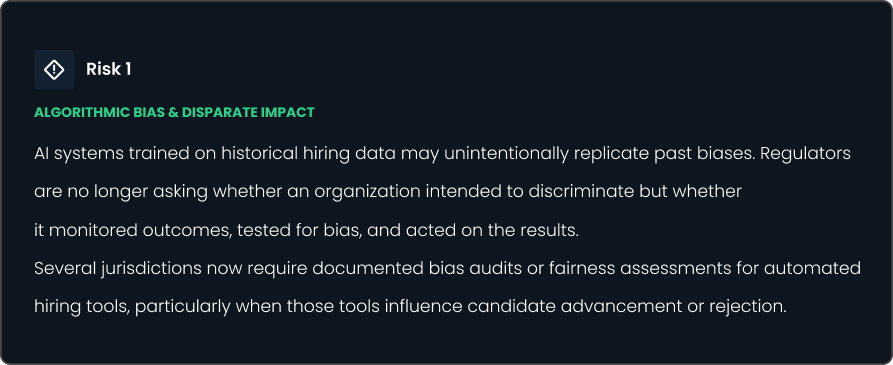
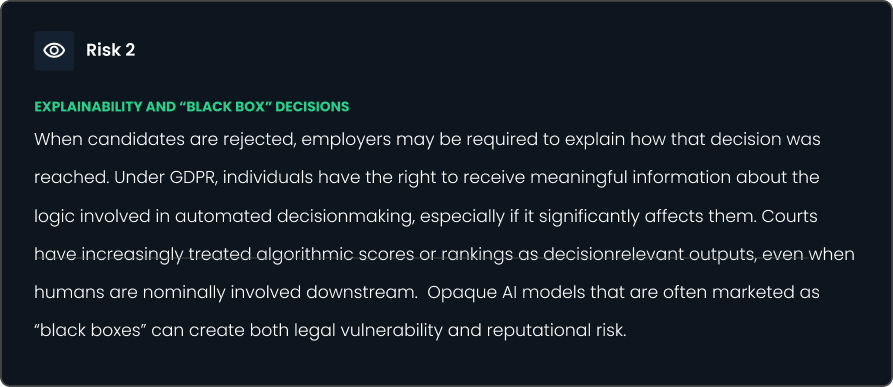
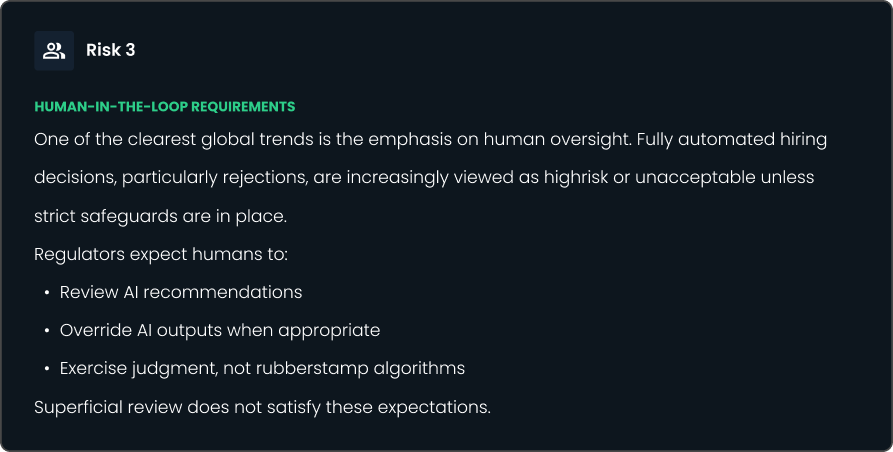
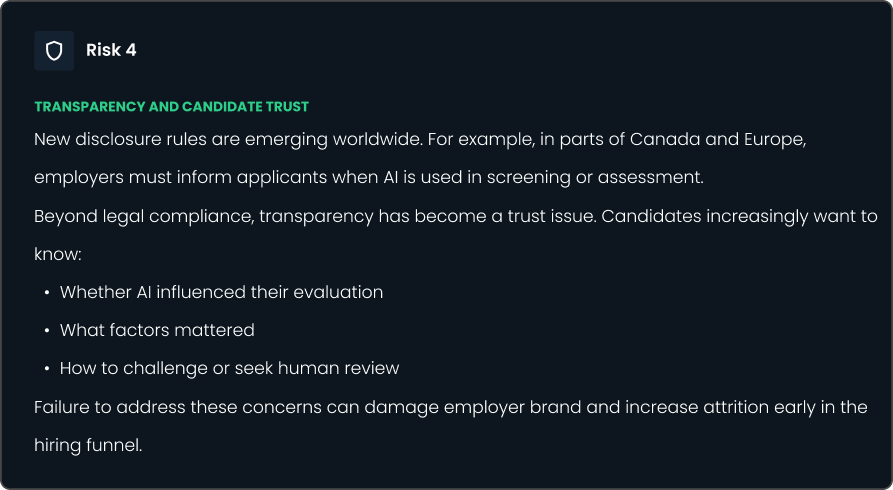
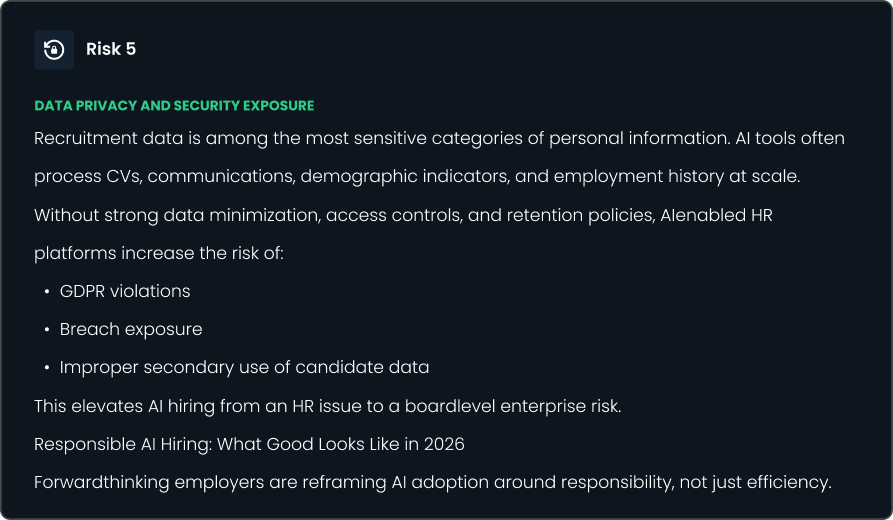
This elevates AI hiring from an HR issue to a boardlevel enterprise risk.
Responsible AI Hiring: What Good Looks Like in 2026
Forwardthinking employers are reframing AI adoption around responsibility, not just efficiency.
Key best practices are emerging:
- AI as decision support, not decision replacement
- Explainability built into workflows, not added later
- Human checkpoints embedded in hiring pipelines
- Regular monitoring for bias and unintended impact
- Clear candidate communication and escalation paths
- Strong internal governance for AI configuration and use
Organizations that adopt these principles are finding that responsible AI deployment builds trust, resilience, and longterm scalability—not just faster hiring cycles.
The Takeaway
AI will continue to transform HR and recruitment. The question is no longer whether employers should adopt AI, but how responsibly they do so.
In 2026, the organizations that succeed will be those that recognize a simple truth:
The real competitive advantage is not AI that hires faster—but AI that can be trusted, explained, and defended.
As regulation increases and candidate expectations evolve, balancing innovation with governance will define the next generation of digital hiring.
Your AI strategy isn’t complete until your AI governance strategy is.
If you’d like to explore these ideas further, join our upcoming, Celestial Systems Open House – A chance to meet our team, see our latest solutions in action, and discuss how AI can be applied in your own organization.
We’d love for you to join the conversation.