
Enterprise AI has moved beyond chatbots and isolated copilots. AI agents can now retrieve information, invoke tools, interact with APIs, communicate with other agents and, increasingly, take actions that affect business processes.
AI agents are moving faster than traditional governance
They may be created in cloud AI platforms, SaaS applications, analytics environments or custom frameworks, often by different teams operating under different governance models.
For regulated enterprises, that creates a new challenge:
How do you govern something when you do not have a reliable picture of everything that exists, what it can access, what it is authorized to do, and what it does?
Traditional application inventories were designed primarily to record systems, owners, interfaces and infrastructure. Agent governance must go further because the risk includes an agent’s authority, observed behavior, dependencies, business impact and the evidence required to reconstruct consequential actions.
The answer is not necessarily to force every agent onto one centralized platform. Instead, organizations need a living agent system of record: a continuously maintained portfolio connecting every material agent to its ownership, purpose, authority, dependencies, data, risk, controls, behavior, value and evidence.
Why is a model registry no longer enough?
A model registry answers important questions about models and deployments.
An agent inventory needs to answer a different set of questions:
- Who owns this agent?
- What business purpose does it serve?
- Which data can it access?
- Which model and model version does it uses?
- Which tools, APIs and other agents can it call?
- What is it authorized to read, write, recommend, approve or execute?
- Where does human oversight occur?
- What happens when something goes wrong?
- Can its actions be reconstructed later?
- Does it continue to create enough business value to justify its risk and cost?
That difference becomes particularly important in regulated environments. An agent helping draft an internal memo creates a very different risk profile from an agent influencing credit decisions, handling clinical information, communicating with patients or supporting critical infrastructure operations.
Governance therefore needs to follow authority and consequence, not simply whether a system has been labelled an “AI agent.”
Start with visibility: build a living agent system of record
An annual spreadsheet exercise will not keep pace with an agent estate that changes continuously.
Organizations need a synchronized record, wherever practical, with platforms where agents are created, configured, deployed, monitored, changed and retired.
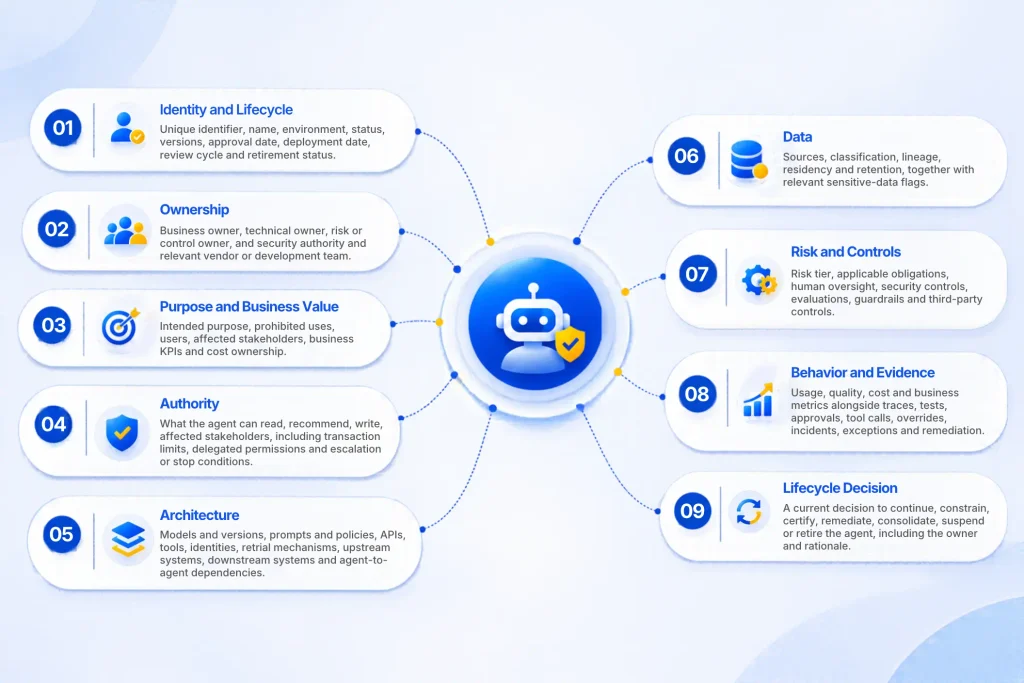
These dimensions form the minimum viable schema proposed in Celestial’s governance framework. The important distinction is that the inventory should capture not just what an agent is, but what it is authorized to become.
Risk-tier agents by authority and impact
Not every AI agent requires the same degree of governance.
A practical model can use four operating tiers:
| Tier | Typical Profile | Governance Response |
|---|---|---|
| Tier 1: Limited | Internal assistance, no sensitive data or external action | Ownership, purpose, approved tools, basic logging |
| Tier 2: Moderate | Sensitive internal information or material workflow, primarily advisory | Security/privacy review, testing, access controls and monitoring |
| Tier 3: High | Influences regulated, customer, patient, employee, financial or operational decisions | Independent challenge, documented human oversight, evidence retention and recurring recertification |
| Tier 4: Critical | Can execute consequential changes affecting safety, infrastructure, legal rights or high-value transactions | Explicit authority boundaries, pre-deployment approval, fail-safe mechanisms, continuous monitoring and rigorous change control |
The critical point is that autonomy alone should not determine risk.
An advisory agent can still create significant exposure when people routinely accept its recommendations in a consequential process. Risk classification should therefore account for impact, data sensitivity, external actions, reversibility, scale, jurisdiction, cybersecurity exposure and dependency concentration alongside autonomy.
Audit the system, not just the model
The same principle applies to auditing.
A model evaluation tells you something about model performance. It does not necessarily tell you whether an enterprise agent is operating safely.
A defensible agent audit should examine the complete operating system around the model.
A practical sequence is:
- Set the scope: Define business units, platforms, environments, jurisdictions and evidence periods.
- Discover: Reconcile cloud inventories, SaaS environments, source repositories, APIs, identities, procurement records and observability systems.
- Establish identity: Assign a unique ID and distinguish versions, clones and agent-to-agent dependencies.
- Confirm accountability: Verify business, technical, security, risk and approval owners.
- Validate purpose and value: Compare stated intent with actual usage, outputs, costs and business outcomes.
- Reconstruct authority: Examine identities, roles, tools, APIs, transaction limits and delegated permissions.
- Trace data and models: Document data sources, lineage, residency, model versions, prompts and retrieval sources.
- Assess regulatory scope: Map applicable laws, regulations, supervisory requirements, contractual requirements and internal policies without treating them as equivalent.
- Challenge controls: Test access, prompt injection, unsafe tool use, failure modes, guardrails, resilience, bias and prohibited-use boundaries.
- Test human oversight: Determine whether reviewers have enough information, competence and authority to challenge, override or stop the agent.
- Verify evidence: Sample inputs, outputs, traces, tool calls, approvals, changes, incidents and exceptions.
- Make a lifecycle decision: Certify, constrain, remediate, consolidate, suspend or retire, with named actions and dates.
This should not be a once-a-year exercise. A material change to an agent’s purpose, authority, model, prompt, tools, data, jurisdiction, user population or potential impact should trigger reassessment.
Governance and security must converge
Agent governance and cybersecurity cannot operate as separate disciplines.
An agent’s permissions, identity, connected systems and data flows define a significant part of its risk. Its governance record therefore needs to connect with identity management, security operations, information protection, cloud controls, monitoring and incident response.
That principle aligns with Celestial Systems’ broader security approach: security should exist across applications, cloud infrastructure, data and AI instead of being treated solely as a perimeter or point-in-time activity.
Related :
- Celestial recently announced achieving Microsoft Solutions Partner designation for Security (in addition to Data & AI, Digital & App Innovation and Infrastructure).
- Celestial Systems achieved ISO/IEC 42001:2023 certification for its Artificial Intelligence Management System earlier this year. The certification provides a structured management system framework for AI-related risk, accountability and responsible deployment. Together, these capabilities illustrate an increasingly important principle:
AI governance defines responsible operation. Security helps enforce its boundaries. Evidence demonstrates that both are working.
A federated model is more realistic than forced centralization
Large enterprises are unlikely to build every agent using the same platform. Agents may exist across Microsoft, AWS, Snowflake, Dataiku, SaaS products and custom frameworks. The goal therefore should not automatically be runtime consolidation.
The better architectural principle is:
Federated build. Centralized evidence.
Platform teams can retain the technologies best suited to their use cases, while the organization maintains common standards for identity, classification, accountability, monitoring, evidence and portfolio reporting.
The governance layer then becomes the connective tissue across a heterogeneous estate.
Getting started: a 90-day roadmap
Enterprises do not need a perfect governance platform before they begin.
A practical first 90 days can be structured around three outcomes.
Days 1–30: Establish visibility
Identify the executive sponsor and scope. Establish a common agent definition and interim schema. Discover agents across priority platforms, identify owners, assign provisional risk tiers and document critical unknowns.
Days 31–60: Validate and control
Reconcile inventory records with technical sources. Map permissions, authority and dependencies. Identify orphaned, duplicate and unmanaged agents. Establish tier-based controls and audit a representative sample of high-risk agents.
Days 61–90: Operationalize
Connect priority metadata feeds. Establish recertification workflows, portfolio dashboards and evidence packs. Integrate agent changes and incidents into governance triggers and agree with the target operating model.
And measure the right thing. The first governance KPI should not simply be the number of agents cataloged.
A more meaningful measure is:
Percentage of material agents with verified ownership, purpose, authority, risk classification, controls and current evidence.
How Celestial Systems can help
Celestial Systems help enterprises assess how AI platforms, cloud environments, governance technologies, observability systems, identity controls and existing enterprise security capabilities can work together as a federated AI governance architecture.
Our approach combines AI governance with enterprise security and implementation experience.
Start with an Architecture Readiness Review to map your agent estate, governance gaps, security boundaries and evidence architecture before agent sprawl becomes an audit or operational problem.